Reading the Tractatus

Wittgenstein begins his preface to the Tractatus Logico-Philosophicus thus: “This book will perhaps be understood only by someone who has already thought the thoughts expressed in it themselves—or at any rate similar thoughts.” This is a very difficult ask of a reader.
The propositions of the Tractatus alone do not explain themselves. One cannot understand the text without in some sense reproducing Wittgenstein thoughts in the process of composing it. It is as if to understand the work, one has to be capable of writing it. In Borges’s famous story, the French writer Pierre Menard dedicates his life to producing a few chapters of the Quijote word by word, composing this work identical on the surface to Cervantes’s text from the learning and influences and feelings of a 20th century French writer. To understand the Tractatus’s text alone it seems would require such a dedication.
But I wanted to understand the Tractatus, and fortunately there are many to make it more accessible. The first help is that the original German has been translated, initially with Wittgenstein’s guidance by Frank Ramsey, then by David Pears and Brian McGuinness representing some of the Oxford legacy of Wittgenstein’s teaching, and now by several more since the text’s passage into the public domain including Michael Beaney and Damion Searls.
Wittgenstein scholarship has also advanced and produced in its time many commentaries, speculations, and elaborations on his first published work. Elizabeth Anscombe produced her introduction to the work partially rooted in conversations with the philosopher himself while looking back on his earlier work, Cora Diamond and James Conant propounded the influential resolute reading of the text and historically minded scholars have gone through every notebook and draft of the work, tracing each sentence through its evolutions over the years. This is all supplementary to the biographical work done on the philosopher, particular Ray Monk’s famous Wittgenstein: The Duty of Genius.
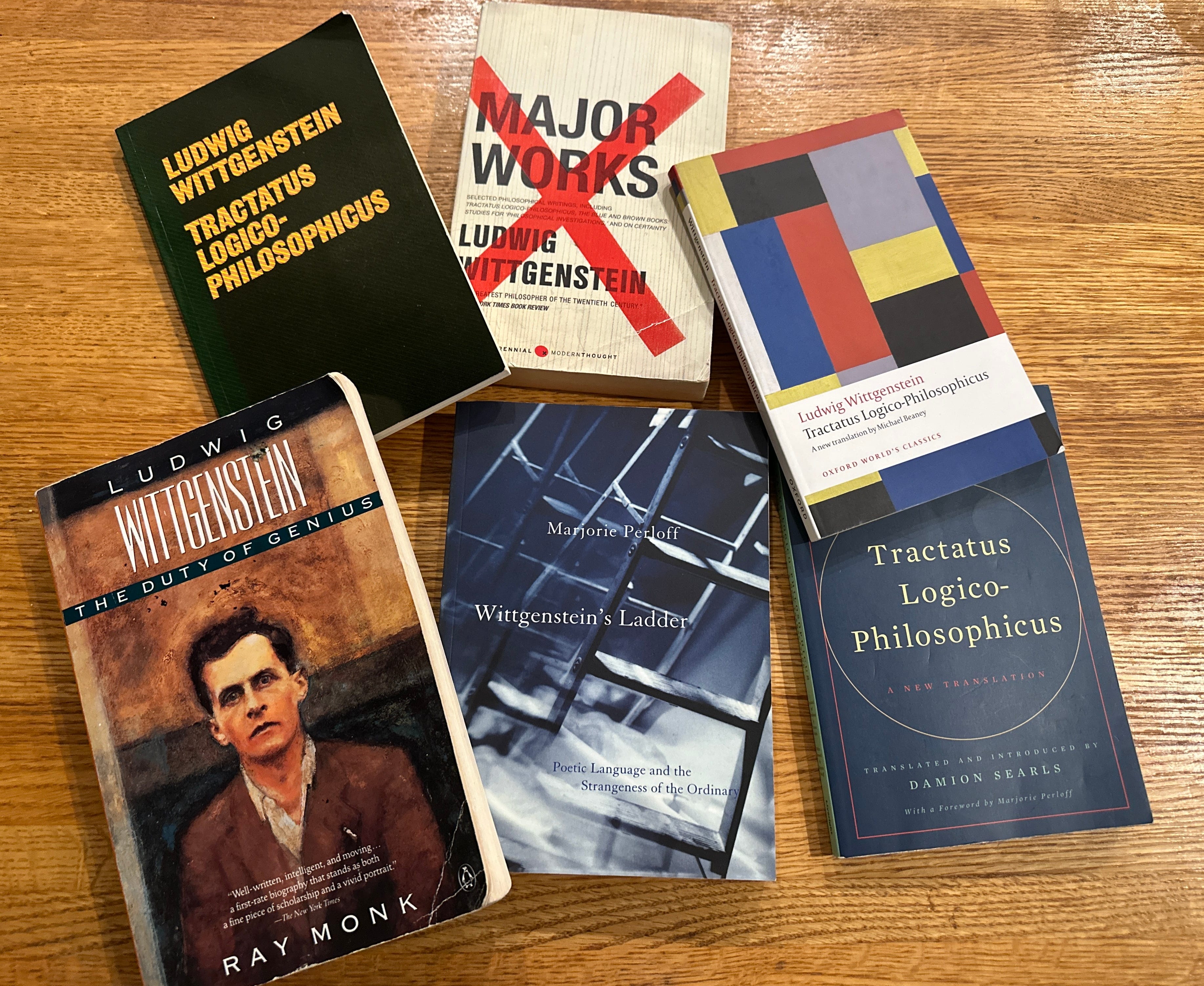
Just over a century after its initial publication, the Tractatus has accrued a body of commentary which puts it on the same path as the Bible or the Confucian classics. There is a way to read each proposition not just with the thoughts it immediately inspires in the readers, but accompanied by the hundreds of thoughts in this growing tradition, all directed towards thinking what its creator really had in mind. It is much easier to understand the Tractatus now than when Wittgenstein published his pessimistic preface.
But it is not necessarily easier to read. There are a lot of books, many of them disagreeing, and to read the Tractatus becomes a matter of either taking on a dedicated study of all the prerequisites before getting to the text itself or juggling between volumes in an exercise more of triangulating contexts than thinking through reality.
I wanted to understand the Tractatus, and I wanted to make it easier, so I made my own version of the book.
First, I wanted to read it in its original German. The Tractatus consists of 7 full propositions, each with successive stages of further propositions elucidating them. So proposition 1 is explicated by propositions 1.1 and 1.2, 1.1 by 1.11, 1.12, 1.13 and so on. Wittgenstein chose his aphoristic, sparse, poetic style deliberately. Each proposition is supposed to be contemplated on its own, and he refused to compromise the beauty of the work by adding long explanatory paragraphs or examples. This was a process which fell to the commentators. The personal style of his German, how he wrote in his notebooks through to the end of his life, carries with it much of the work’s singular quality and I wanted to experience it that way.
The Tractatus argues that different systems of signs, especially dealing with logic, can be reduced to a more perspicuous system, meaning that more complex human languages can in the end be perfectly translated. The Tractatus also doesn’t leave room for empirical challenges to the purely logical, but the text’s own history might be one such example.
Wittgenstein wrote in his own native tongue, and from biographical sources seems to have never become a comfortably fluent English speaker, awkward phrases persisting through the end of his life. The first translation was by Frank Ramsey, who it seems also had only a student’s grasp of German, and so despite Wittgenstein’s supervision the consensus now seems to be that it is highly imperfect. These two geniuses working in concert could not find a way to make it clearly correspond to the German. Yet, Wittgenstein scholarship has been largely anglophone, and it has adopted the terms from the Ramsey-Ogden translation (C.K. Ogden supervised the publication and got his name first on Ramsey’s translation), until the Pears-McGuinness translation replaced it in 1961 with its own set of specialized terms. Neither the German, nor any one translation, is sufficient to keep it all straight. The Tractatus makes the case that the world can fully be described by Sachverhalte, elementary states of reality for which Ramsey chose the term “atomic facts”, but these are also related to the more complex Sachlagen which is sometimes translated as “states of affairs” sometimes “circumstances”, terms which seem distant from each other where the German is quite close. Meanwhile Pears-McGuinness chose “states of affairs” to be the atomic Sachverhalte, and “situations” for Sachlagen, while Beaney (who through this process I’ve grown to trust most) chooses “state-of-things” for Sachverhalte and “state of affairs” for Sachlagen. To understand and communicate within the tradition, one must not only understand the base facts of the text (the German) but also the varied signs employed in the translation for the same word.
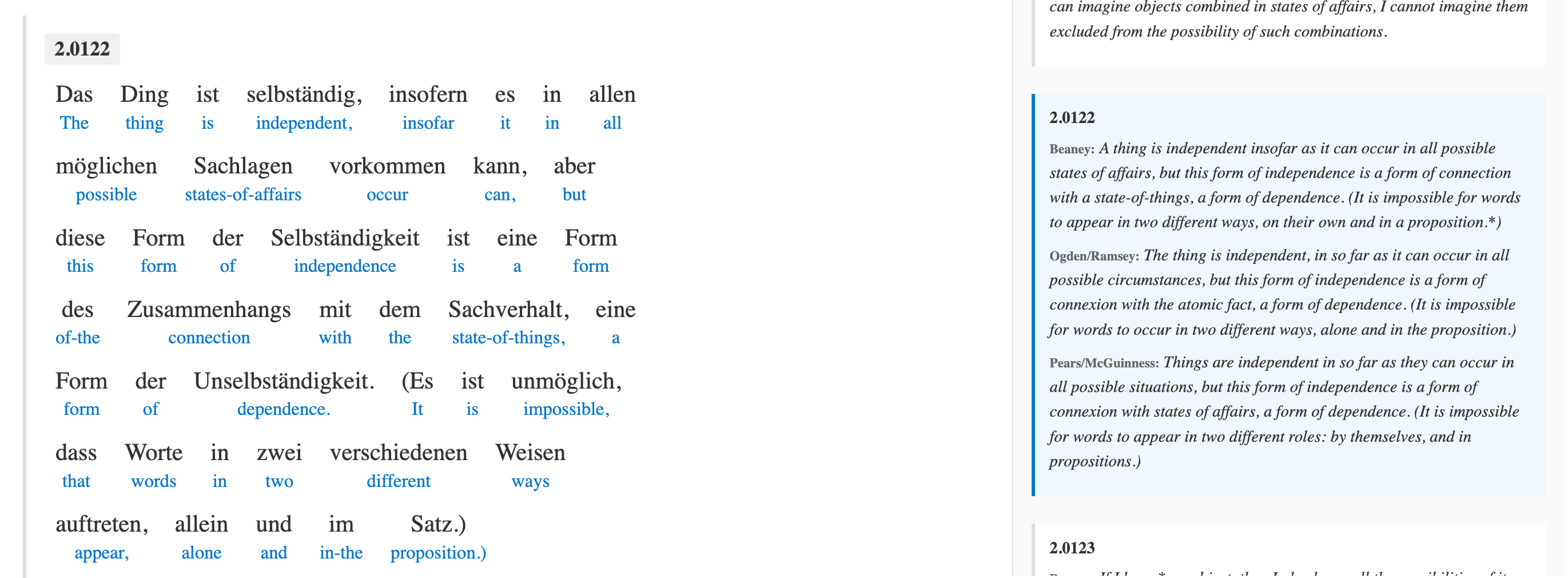
So I used my tool, Gloss, to make an edition with the German text first, so I could gradually become used to Wittgenstein’s style and vocabulary, approaching each proposition on its own term, and slowly learning German through it. And then, on the side I had the three different translations named above. Thus I was reading the words, and all the words derived from them.
Translations are necessarily interpretations, and reading multiple translations is a good way to grasp the essence underlying all of them. But this was not sufficient to understanding the Tractatus. I read Beaney’s introduction as well as the first few chapters of a wonderful commentary by Marie McGinn which were helpful in grasping the main points and structure of the text. However I struggled to understand the actual propositions themselves with their own isolated meaning. The Tractatus says “A thought is a senseful proposition” and whether the propositions of the Tractatus have sense or not (a point much debated in the literature) and I wanted to be able to grasp each one.
Rather than cross referencing commentaries switching between books, I added them to my text. James C. Klagge’s Tractatus in Context is already structured in such a way that it follows the text. Most propositions have a corresponding paragraph or so in the Klagge which explains the drafts and specific history of the thought Wittgenstein published. So I added his commentary below each proposition, expandable for examination.
Klagge provided the context, but he did not explain the philosophical meaning within the system, leaving that to readers and commentators, such as Marie McGinn. McGinn’s work, Elucidating the Tractatus, is not arranged according to the structure of the text she is explaining, actually beginning in the middle of the work and declining to go over each proposition. But reading her interpretation made the whole system make sense. I started by going through her commentary ahead of the sections I was going to read in the text, but then I would often have trouble connecting the propositions themselves back with confidence. There was no real way to insert the text of her commentary into the Tractatus itself, since the structures completely failed to mirror each other. Similarly if I read the McGinn after the Tractatus, she would quote some proposition, say 5.442, and without the text in front of me I could not remember it well enough to achieve clarity for that particular proposition. So I used a final tool at my disposal.
I had an LLM (specifically Claude Opus 4.5) write a proposition by proposition commentary with McGinn’s book in its context window, with instructions to cite and quote the parts where a proposition is specifically mentioned, and otherwise to make a reasonable explanation grounded in McGinn’s overall argument. The prose was lacking and the explanations were a bit repetitious and shallow, but the fundamental task of understanding each sentence as McGinn’s commentary would have it was achieved.
Now the process of reading each proposition was to approach the original German, inspect the translations, understand the context, and then to read the commentary. This was necessarily built on a foundation of going through the commentary in full bit by bit, taking notes on introductions, biographies, etc. But the moment of actual reading was now complete, the private poetry of Wittgenstein’s German united to all the supplementary interpretations which allowed me to understand what it actually meant.
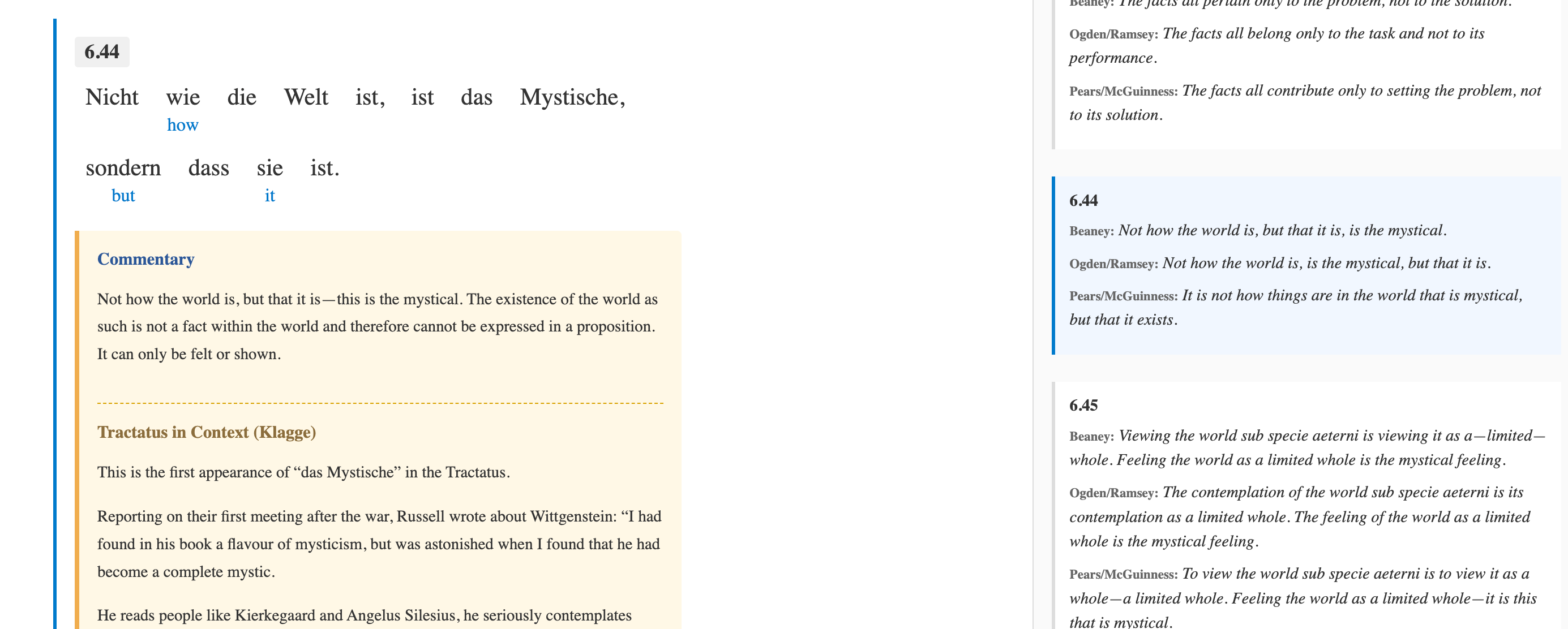
Do I actually, truly understand the Tractatus as Wittgenstein would have? Not quite. A few years immersed in obsession with the problems of logic of Frege and Russell would probably be necessary for that. But I have read the work in a more complete way than perhaps was previously possible without an exhaustive academic workflow of several volumes spread out, stretching my memory past its casual limits. And I feel able to move on.
The system that Wittgenstein built was beautiful, an elegant understanding of propositions as pictures, and logic as a simple arrangement which makes clear what should be clear. It failed though, as Wittgenstein later realized, for reasons of internal consistency (the non-independence of elementary propositions, which McGinn discusses extensively) but also of narrowness. What Wittgenstein thought was logic, the underlying formal structures which make pictures of the world possible, was itself but one picture of what language could do. Meaning is not reducible down to elementary facts, translation into the world of the everyday is the messy underlying reality. But where the Tractatus still offers a help is the idea that through the careful arrangement and use of everyday language, we can clarify and understand, and dissolve our worries that we are missing what’s really there.